ECS 005 | ENGINEERING CASE STUDIES | Unexpected Strength Loss in M35 Concrete Due to Incorrect Admixture Dosage

DMSA Engineering Case Study (ECS-005) | Engineering Investigation of Incorrect Admixture Dosage in M35 Concrete
Unexpected Strength Loss in M35 Concrete Due to Incorrect Admixture Dosage is a real engineering investigation carried out by DM Strategic Advisors (DMSA) after an M35 concrete mix consistently failed to achieve the required compressive strength. This Engineering Case Study explains how incorrect admixture dosage in M35 concrete resulted in delayed setting, poor strength development and weak paste-to-aggregate bonding. The investigation demonstrates why batching plant process control should always be verified before questioning cement quality, GGBS quality or concrete mix design.
Project:
Anonymous Construction Project
September 2026
Engineering Case Study Background
This Engineering Case Study is based on an actual engineering investigation undertaken by DM Strategic Advisors (DMSA). Project and client information have been anonymised to maintain confidentiality while sharing the engineering learning.
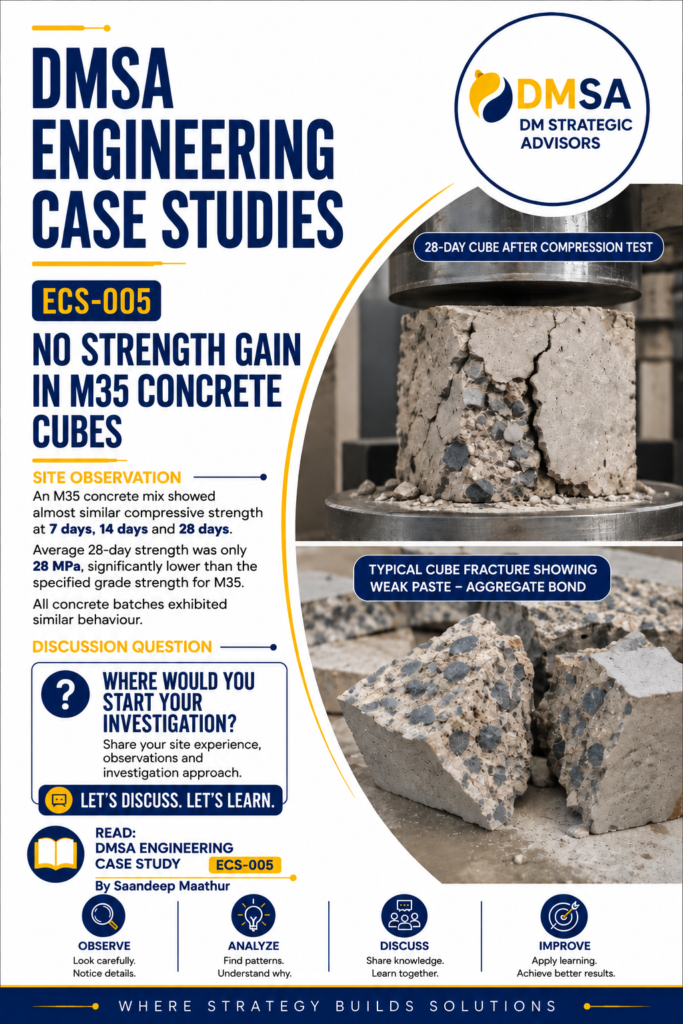
The investigation was initiated after multiple production batches of M35 concrete recorded significant strength loss. The average 28-day compressive strength was only 28 MPa instead of achieving the specified M35 concrete strength requirement. The engineering objective was to identify whether the problem was related to concrete materials, mix design or batching plant operations.
Objective
To investigate the root cause of unexpected strength loss in M35 concrete and establish whether incorrect admixture dosage in M35 concrete was responsible for the observed strength deficiency.
Problem Statement
An M35 concrete mix showed consistently poor strength development across multiple production batches. The average 28-day compressive strength was only 28 MPa, creating concerns regarding cement quality, GGBS performance and concrete mix design. Since the strength deficiency appeared in all batches, a detailed engineering investigation became necessary.
Site Observations
Concrete Grade : M35
Binder Content : 400 kg/m³
- Delayed setting of concrete was observed at site.
- Slow strength development was noticed in concrete cubes.
- Poor bond between cement paste and coarse aggregate was observed during cube failure.
- Similar strength deficiency was observed across all production batches.
- Average 28-day compressive strength remained around 28 MPa.
DMSA Investigation
The engineering investigation reviewed every major parameter that could influence M35 concrete strength development before concluding the root cause.
- Cement quality verification.
- GGBS quality verification.
- Concrete mix design review.
- Cube casting and curing practices.
- Batching plant operation records.
- Admixture dosing records.
- Operator batching settings.
Critical Finding
The batching plant operator was instructed to dose 2.44 kg/m³ of admixture. However, the actual batching operation was adding 3.90 kg/m³ of admixture to every concrete batch.
| Specified Admixture Dosage | 2.44 kg/m³ |
| Actual Admixture Dosage | 3.90 kg/m³ |
| Excess Admixture Dosage | 1.46 kg/m³ (Approximately 60% Overdose) |
This incorrect admixture dosage in M35 concrete was consistently repeated across production batches, making it a systematic batching plant process error rather than a one-time mistake.
Root Cause Analysis
Incorrect Admixture Dosage
↓
Systematic Overdose During Batching
↓
Delayed Concrete Setting
↓
Disturbed Hydration Process
↓
Weak Paste-to-Aggregate Bond
↓
Reduced Strength Development
↓
Unexpected Strength Loss in M35 Concrete
The investigation established that incorrect admixture dosage in M35 concrete disturbed the hydration process during the early age of concrete. The excessive dosage delayed setting, reduced early strength development and weakened the bond between cement paste and coarse aggregate, resulting in significant concrete strength loss.
Engineering Assessment
The engineering investigation concluded that the observed strength deficiency was caused by a process control failure rather than an isolated concrete material problem.
Evidence supporting this conclusion included:
- Uniform strength deficiency across all production batches.
- Delayed setting observed during concreting.
- Consistent reduction in 28-day cube strength.
- Verified incorrect admixture dosage during batching operations.
- No evidence indicating cement or GGBS quality failure.
The investigation confirmed that incorrect admixture dosage in M35 concrete was the primary reason for the unexpected strength loss.
Why This Happened
Many concrete strength investigations immediately focus on cement quality, supplementary cementitious materials or mix design. However, batching plant execution errors can produce similar symptoms.
In this case, the concrete mix design was technically correct. The failure occurred because the actual admixture dosage entering the concrete was approximately 60% higher than the specified dosage. The process control error affected every batch and produced consistent strength deficiency throughout production.
Corrective Actions
- Restore admixture dosage to the specified 2.44 kg/m³.
- Verify batching plant admixture calibration.
- Recheck operator dosing settings before production.
- Cast fresh verification batches using the corrected dosage.
- Monitor setting time and strength development after correction.
- Maintain documented batching records for QA/QC review.
DMSA Recommendation
Before modifying an M35 concrete mix design or changing cement and GGBS, always verify the actual admixture dosage entering the batching plant.
Incorrect admixture dosage in M35 concrete should be treated as a batching plant process control issue. Correct the dosing system, verify calibration, retrain operators where required and validate the corrected concrete through fresh production batches.
Engineering Outcome
- Root cause identified as incorrect admixture dosage.
- Cement quality and GGBS quality were not responsible for the strength loss.
- Mix design remained technically acceptable.
- Corrective action focused on batching plant process control.
- Fresh verification batches were recommended after restoring the correct admixture dosage.
SM Engineering Insight
Before blaming cement, GGBS or mix design, verify the actual admixture dosage entering the concrete. A batching process error can appear as a cement compatibility problem, delayed strength gain or poor concrete quality unless the dosing system is investigated through engineering evidence.
Key Learning
Unexpected strength loss in M35 concrete should not immediately be attributed to cement quality or concrete mix design. Accurate batching plant execution is equally important. Even a systematic admixture dosing error can lead to significant concrete strength loss across an entire project, making process verification an essential part of QA/QC investigations.
About this Engineering Case Study
This Engineering Case Study is part of the SM Knowledge Hub (SMKH) by SM Ecosystems. Each Engineering Case Study documents a real engineering investigation, engineering observations, root cause analysis and practical corrective actions for improving concrete quality on construction projects.
Need Technical Assistance?
If your project is experiencing concrete cracking, durability concerns, mix desigor quality-related issues, SM Ecosystems provides engineering consulting, technical investigations, root cause analysis and practical solutions based on field experience and sound engineering principles.
Related Engineering Case Studies
Additional Engineering Case Studies will be published as part of the SM Knowledge Hub to share practical field investigations, engineering solutions and lessons learned from real construction projects.
Tags
Engineering Case Study, ECS-005, High-Strength Concrete Cube Strength Variation, M65 Concrete, Mix Optimisation, Standard Deviation, Production Consistency, QA/QC, DMSA, SM Knowledge Hub