TN – 008 – Technical Notes | Cold Joints in Concrete – Prevention and Repair

Engineering Investigation of Cold Joints in Concrete – Causes, Prevention and Repair
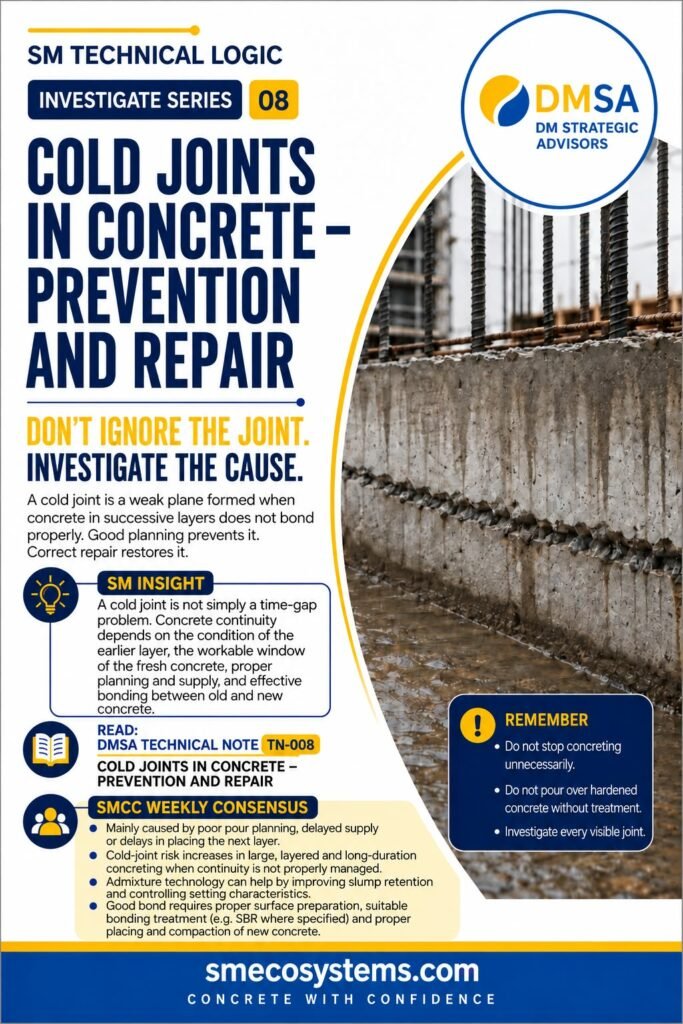
Cold joints in concrete can develop when there is a significant interruption between successive layers of concrete, preventing the new concrete from integrating properly with the earlier layer. Common causes of concrete cold joints include poor pour planning, delays in concrete supply, delays in placing the next layer and inadequate management of the old–new concrete interface. Proper investigation helps identify the causes of cold joints and determine practical measures for prevention and repair.
Objective
To help engineers identify, investigate and prevent cold joints in concrete, with particular focus on pour planning, concrete supply, time gaps, concrete condition and treatment of the old–new concrete interface.
Problem Statement
Cold joints can interrupt the continuity between successive layers of concrete and may affect the performance of the concrete interface. A cold joint should not be treated only as a time-gap problem. The complete concreting operation should be investigated to identify the actual cause and determine appropriate preventive or repair measures.
Background
The causes of cold joints in concrete involve more than the time gap between two layers. Concrete supply, pour planning, concrete condition, workability and setting characteristics, placing and compaction practices, and the condition of the earlier concrete layer all influence the ability of successive layers to integrate properly.
In large raft pours, the risk of cold joints can increase when the first layer loses its ability to integrate properly with the next layer.
Symptoms
- Visible interface or discontinuity between successive concrete layers.
- Concrete layers appearing to have been placed separately rather than integrating properly.
- Evidence of a prolonged interruption during concreting.
- A distinct old–new concrete interface requiring investigation.
- Cold joints occurring at locations associated with delays in concrete supply or concrete placing.
Investigation Checklist
- Record the time gap between the two concrete layers.
- Check the condition of the earlier concrete layer.
- Review concrete supply continuity during the pour.
- Review pour planning and the planned sequence of concreting.
- Check whether delays occurred in placing the next layer.
- Review concrete workability and setting characteristics during the concreting operation.
- Check whether appropriate admixture technology was used to manage long-duration concreting.
- Check the condition of the old–new concrete interface.
- Review surface preparation before placing new concrete.
- Check placing and compaction practices for the new concrete.
Root Cause Analysis
Poor Pour Planning
↓
Delay in Concrete Supply / Placing
↓
Extended Time Gap Between Layers
↓
Earlier Concrete Loses Ability to Integrate Properly
↓
Inadequate Old–New Concrete Interface Management
↓
Cold Joint in Concrete
Recommended Solutions
- Plan the complete concrete pour to minimise interruptions between successive layers.
- Ensure adequate and continuous concrete supply for the planned pour.
- Use an appropriate admixture strategy where long-duration concreting requires management of slump retention and setting characteristics.
- Monitor the time gap between successive layers.
- Where new concrete is placed against an existing concrete surface, ensure proper surface preparation.
- Use suitable bonding treatment where specified.
- Ensure proper placing and compaction of the new concrete.
Preventive Measures
- Prepare a detailed pour plan before starting concreting.
- Ensure adequate concrete supply for the complete planned operation.
- Monitor delays in concrete supply and placing.
- Manage slump retention and setting characteristics according to concreting conditions.
- Monitor the condition of the earlier concrete layer before placing the next layer.
- Give particular attention to layer-to-layer integration in large raft pours.
- Ensure proper treatment of the old–new concrete interface where applicable.
Important Do’s
- Plan the concrete pour before concreting starts.
- Maintain adequate concrete supply.
- Monitor the time gap between successive layers.
- Check the condition of the earlier concrete layer.
- Use an appropriate admixture strategy for long-duration concreting where required.
- Prepare the concrete interface properly when new concrete is placed against old concrete.
- Ensure proper placing and compaction of new concrete.
Important Don’ts
- Do not treat a cold joint as only a time-gap problem.
- Do not ignore delays in concrete supply or placing.
- Do not ignore the condition of the earlier concrete layer.
- Do not place new concrete against an inadequately prepared old concrete surface.
- Do not overlook the role of concrete workability and setting characteristics during long-duration concreting.
- Do not treat repeated cold-joint problems as isolated incidents without reviewing the complete concreting operation.
Relevant IS Codes
Relevant IS codes should be verified against the specific cold-joint investigation, repair method and concreting condition before inclusion in the Technical Note.
Practical Tips
- A cold joint is best prevented before it happens.
- The time gap between concrete layers is one of the first investigation points, but it is not the only factor.
- The condition of the earlier concrete layer is equally important.
- In large raft pours, continuous planning and concrete supply are critical.
- Admixture technology can help manage the risk during long-duration concreting.
- Proper surface preparation, suitable bonding treatment where specified, placing and compaction are important when new concrete is placed against old concrete.
SM Insights
Cold joints in concrete are rarely the result of one isolated mistake. They are usually the outcome of a concreting operation in which time, concrete condition, planning and the concrete interface are not managed together.
Key Learning
Cold joints should be investigated as a complete concreting-operation problem involving pour planning, concrete supply, time gap, concrete condition, admixture strategy, interface condition and placing practices.
Cold joints should be investigated as a complete concreting-operation problem involving pour planning, concrete supply, time gap, concrete condition, admixture strategy, interface condition and placing practices.
Good planning, adequate concrete supply, appropriate admixture strategy, proper placing and compaction, and correct treatment of the old–new concrete interface can significantly reduce the risk of cold joints in concrete.
KEY ENGINEERING INSIGHT
Don’t Reject.
Investigate.
Know Your Concrete before taking an engineering decision.
Engineering excellence is not only about producing consistent cube strengths.
It is about ensuring that the recorded data truly represents the concrete we produce.
Download Technical Note TN 008
Download the complete DMSA Technical Note (PDF) for reference, sharing and field implementation.
Tags TN 008
cold joint in concrete, causes of cold joints, concrete cold joint, cold joint prevention, cold joint repair, concrete interface, old and new concrete interface, concrete pour planning, concrete placing, concrete quality control
Version 1.0
DMSA Technical Knowledge Library
Need Concrete Engineering Support?
If you need assistance with concrete quality, mix design optimization, technical audits, root cause analysis, troubleshooting or engineering training, SM Ecosystems provides practical engineering consulting based on industry experience.
About DMSA Technical Notes
DMSA Technical Notes are practical engineering knowledge documents developed by SM Ecosystems to help engineers, consultants, contractors and quality professionals solve real construction challenges through systematic investigation, engineering principles and practical solutions.