TN – 006 – Technical Notes | Plastic Shrinkage and Plastic Settlement Cracks

Engineering Investigation of Plastic Shrinkage and Plastic Settlement Cracks
Plastic shrinkage and plastic settlement cracks are among the earliest cracks observed in concrete, often developing within the first few hours after placement, before the concrete has hardened. Although these cracks are usually non-structural, they are important indicators of problems related to weather conditions, concrete properties, placement, finishing and curing practices. Identifying the root cause during the fresh concrete stage helps prevent durability problems and unnecessary repairs later.
Objective
To help engineers identify, investigate and prevent plastic shrinkage and plastic settlement cracks before concrete hardens.
Problem Statement
Cracks appearing within the first few hours after concreting are often ignored or treated as surface defects. In reality, they indicate problems during the early life of concrete and should be investigated immediately to prevent long-term durability issues.
Background
Before concrete sets, water movement, rapid evaporation and settlement of fresh concrete can produce cracks. Plastic shrinkage cracks develop when moisture evaporates from the concrete surface faster than bleed water reaches the surface. Plastic settlement cracks develop when fresh concrete settles around reinforcement or embedded items. Although these cracks form before hardening, they may reduce durability and provide paths for water and aggressive chemicals.
Symptoms
- Fine random cracks on slab surfaces.
- Parallel cracks above reinforcement.
- Cracks appearing within 1 to 6 hours of concreting.
- Surface dries rapidly during finishing.
- Cracks become wider in hot, dry and windy weather.
Investigation Checklist
□ Record air temperature, concrete temperature, wind speed and relative humidity.
□ Check concrete temperature at the time of placement.
□ Review the time interval between placing and finishing.
□ Verify when curing started after finishing.
□ Inspect crack pattern, direction and location.
□ Observe reinforcement spacing and congestion.
□ Review placement, compaction and finishing practices.
Root Cause Analysis
Weather Conditions
↓
Concrete Properties
↓
Placement Practices
↓
Finishing Practices
↓
Curing Delay or Moisture Loss
↓
Plastic Shrinkage / Plastic Settlement Crack Formation
Recommended Solutions
- Start curing as early as possible after finishing.
- Protect fresh concrete from wind and direct sunlight.
- Use fogging or evaporation reducers where required.
- Place concrete during cooler hours whenever possible.
- Optimize the concrete mix to reduce bleeding while maintaining cohesiveness.
- Avoid excessive or repeated finishing operations.
Preventive Measures
- Plan concreting according to weather forecasts.
- Monitor evaporation conditions during concreting.
- Keep curing materials ready before concreting begins.
- Cover exposed concrete immediately after finishing when required.
- Train site staff to recognize early-life cracking and respond immediately.
Important Don’ts
- Start curing without unnecessary delay.
- Protect concrete from rapid moisture loss.
- Monitor weather conditions throughout concreting.
- Investigate early cracks immediately instead of assuming they are harmless.
Important Don’ts
- Do not ignore hairline cracks appearing within a few hours.
- Do not delay curing after finishing.
- Do not overwork or over-finish the concrete surface.
- Do not carry out concreting in extreme weather without protective measures.
Relevant IS Codes
- IS 456 — Plain and Reinforced Concrete — Code of Practice.
- IS 7861 (Part 1) — Code of Practice for Extreme Weather Concreting.
- IS 10262 — Concrete Mix Proportioning — Guidelines.
- IS 4926 — Ready Mixed Concrete — Specification.
Practical Tips
- Most plastic cracks develop before concrete gains sufficient strength.
- Prevention is significantly easier and more economical than repair.
- Weather planning is one of the simplest and most effective quality control measures.
- Early curing is one of the best investments for producing durable concrete.
SM Insights
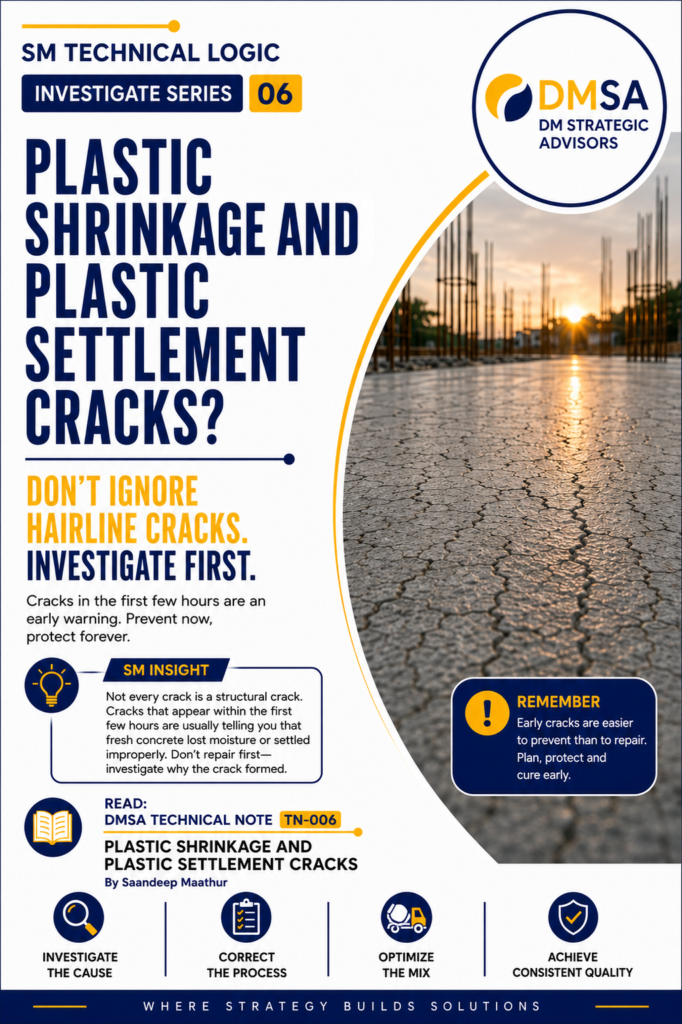
Not every crack is a structural crack. Cracks that appear within the first few hours are usually telling you that fresh concrete lost moisture too quickly or settled improperly around reinforcement. Don’t repair first—investigate why the crack formed.
Key Learning
Plastic shrinkage and plastic settlement cracks are early warning signs during the fresh concrete stage. Proper planning, weather management, timely curing and good site practices can prevent most of these cracks before concrete hardens.
KEY ENGINEERING INSIGHT
Don’t Reject.
Investigate.
Know Your Concrete before taking an engineering decision.
Engineering excellence is not only about producing consistent cube strengths.
It is about ensuring that the recorded data truly represents the concrete we produce.
Related Technical Notes
TN-001 — Cold Joints in Concrete
TN-002 — Honeycombing in Concrete
TN-003 — Surface Voids and Bugholes in Concrete
TN-004 — Cracks in Concrete During Early Age
TN-005 — Segregation and Bleeding of Fresh Concrete
Download Technical Note TN 006
Download the complete DMSA Technical Note (PDF) for reference, sharing and field implementation.
Tags TN 006
Technical Note, TN-006, Plastic Shrinkage Cracks, Plastic Settlement Cracks, Early Age Cracks, Fresh Concrete, Concrete Cracks, Curing, DMSA, SM Knowledge Hub
Version 1.0
DMSA Technical Knowledge Library
Need Concrete Engineering Support?
If you need assistance with concrete quality, mix design optimization, technical audits, root cause analysis, troubleshooting or engineering training, SM Ecosystems provides practical engineering consulting based on industry experience.
About DMSA Technical Notes
DMSA Technical Notes are practical engineering knowledge documents developed by SM Ecosystems to help engineers, consultants, contractors and quality professionals solve real construction challenges through systematic investigation, engineering principles and practical solutions.